Massive Attack’s “Blue Lines”

Album cover for Massive Attack's "Blue Lines"

This week, I’ve been listening to Massive Attack’s 1991 debut album “Blue Lines” for lessons I can learn as a songwriting musician. “Blue Lines” gets praise for it’s groundbreaking style opening the way for the genre of trip hop for the rest of the decade.I was completely unaware of Massive Attack throughout the 90s. In the early 2000s, I heard a bit of the 1998 album “Mezzanine,” but I honestly can’t say I remember anything about it.  I liked the atmosphere of other trip hop artists, especially Portishead. Somehow, a copy of Massive Attack member Tricky’s solo album “Pre-Millennium Tension” found its way into my collection and I enjoyed bits of it.

So, I was looking forward to my week with this album. Overall, this album was disappointing. It’s not that it’s bad, in fact some of it is quite good. I had expectations that it could not live up to.  To my ears today, it’s not remarkably interesting or special. I was anticipating something more like the trip hop that followed it, and really it’s hip-hop inspired pop music of the mid-90s. Perhaps what made it innovative was influential to other artists that took it further, making the original sound kind of quaint.

Like much hip-hop, the music of Massive Attack is largely sample-based. Though, as I understand, combining original music with samples was part of the innovation here. But even the SugarHill Gang was doing this back in 1979. The use of samples does not pose a problem for me, but I was disappointed to learn that the bassline from “Safe From Harm” is a sample from Billy Cobham’s “Stratus” which uses the bassline in much the same way. Massive Attack sample, one of the most sampled-artists, Funkadelic for drums.

The opening of the track with atmospheric noise and rolling bassline sounds super-cool. It reminds me of some of DJ Spooky’s (also sample-based) work “Galactic Funk” from 1996. I would assume that’s an example of me hearing the influenced before hearing the influencer. Stylish vocals float over the bassline, sung in a jazz-inflected soulful way by Shara Nelson. 

One of my favorite bits of the song are the male smooth-rapped line “I was looking back to see if you were looking back at me to see me looking back at you.” They cut and manipulate this line to enhance the scratched-record feel already present in the lyrics.

The lyrics of this album frequently disappoint. I don’t know if I can condone mispronouncing “contagious” to make it rhyme with “dangerous” though. It reminds me too much of Jez’s song “Outrageous” from comedy show “Peep Show.” Also, this album provides reminders that if the listener can figure it out, maybe you shouldn’t spell it out. Like in the otherwise decent reggaeish track “One Love” when he says “They say don’t lay your eggs in one basket;
If the basket should fall all the eggs’ll be broken.” 

The smooth track “Blue Lines” features cool samples from Tom Scott and the L.A. Express. Some clean funky guitar comes from a song by The Blackbyrds. I recognize the Blackbyrds sample from several other hip hop songs around the same time. Again, the vocal are smooth rap delivered in an effortless way that contradicts much of the “spit” or harder-edge rap. Massive Attack often opt for cool over brag:

Somebody da-ditty, nobody
Walking on sunshine, but, still, we’re treading water
The son of many reasons searching for the daughter
Seeking knowledge, not acknowledging the jet-set
Silver papers of the sound within my Budakon headset
The solar system watches in wisdom
The children dance as the moonlight kissed them

The closing track “Hymn of the Big Wheel” features all original music, as far as I can find researching online. It stands also as one of the musically stronger songs. Pulsating synths provide a drone-like effect as heard in Indian or Scottish music. Over this, the vocals sing in a hymn-like melody lyrics that almost achieve what they try to do.  Again, there’s some disappointing lyrics. The line “There’s a hole in my soul like a cavity” seems rather redundant, considering “cavity” is a synonym for “hole.” Still, overall the song is a hymn, some of the best lyrics on the album.

As a child’s silent prayer my hope hides in disguise
While satellites and cameras watch from the skies
An acid drop of rain recycled from the sea
It washed away my shadow burnt a hole in me
And all the king’s men cannot put it back again
But the ghetto sun will nurture life
And mend my soul sometime againThe big wheel keeps on turning
On a simple line day by day
The earth spins on its axis
One man struggle while another relaxes

While I enjoyed some of this album, I don’t feel I’ll be returning to it. Also, this isn’t a collection of songs I see having much influence on my own music. Still, glad I finally heard it and devoted a week getting to know it.

The Beatles’ “Rubber Soul”

The Beatles' "Rubber Soul" album cover

I dedicated this week to listening to The Beatles‘ sixth album “Rubber Soul” from 1965. Of course, I’m well aware of the Beatles. My tastes, especially since a teenager, was for their later work from 1967’s “Sgt. Pepper” on. I thought I wasn’t quite so familiar with “Rubber Soul,” but some of my favorites are on this album as well. With so many great songs, it’s difficult to choose only a few songs to focus on.

One of the most noticeable things about “Rubber Soul” on a whole is the hard-panning. During this period, albums often saw both a mono and a stereo release. The mono mix was given more care and attention, often bands like the Beatles were present and involved in the mono mix. The stereo mix was considered by some to be unnecessary, a slight variation of the mono, or worse, a gimmicky trend. 

I’ve seen two main reasons given for the Beatles stereo mixes using hard panning (each track (instrument) is completely in the left, right, or center.) Limitations of the studio equipment provided the first reason. Up until the late-60s, mixing consoles had a three-position switch for panning: Left-Center-Right, or LCR.

Another reason came from concern of playback equipment and what might happen if the stereo record was played on mono equipment. This second reason lead to the Center position being avoided. One “Rubber Soul” everything is either Left or Right. So, if the two channels were summed together as mono, the mix levels would be preserved.  That separation ccan sound nice in a room with wells-spaced speakers; However, it’s a very strange feeling in headphones to have the center be a void and everything is right in one ear or the other.

The album’s second track “Norwegian Wood (This Bird Has Flown)” is a slower folk-rock song in ¾ time with Indian influence. Not only incorporate influence from music of India, it was also the first rock song to feature an actual sitar rather than just imitating the sound with guitars. George Harrison had a genuine interest in Indian music and culture, which had an influence on much of his work.

Lennon’s lyrics about a less-than-satisfying love affair perhaps don’t reflect any sort of connection to the Indian flavor. Though there is a sense of exotic strangeness to the girl’s house, which can be like being a stranger in a foreign land. Apparently the last verse is about burning her house down, but it’s so vague it’s difficult to say. Though, knowing that Lennon has used the phrase “Norwegian wood” to refer to cheap wood paneling helps a little.

And when I awoke I was alone

This bird had flown

So I lit a fire

Isn’t it good Norwegian wood?

The intro and verse probably have no real chord progression, but rather stay in the I chord continuously. At the very least a chord progression of I-v7-IV is implied by the melodic riffs. In this way, the accompaniment further imitates drones heard in Indian music. The sitar plays a riff in the left channel, which doubles the melodic portion of finger-picked acoustic guitar in the right channel. The same melody is almost completely followed by the vocal melody.

I have loved the Beatles “Nowhere Man” as long as I can remember, so definitely since I was a young child. It’s one of those songs that can be appreciated at any age. Gershon Kingsley recorded a great instrumental version of the song using Moog synthesizers that I have adored since first hearing it about 15 years ago. I love the sounds Kingsley has designed for the song, but I also really like the melody of this song. Again, the focus of most Beatles songs is the melody and the accompaniment supports that melody. 

The Beatles keep the instrumentation pretty simple on this track. In the left channel, we have drums, bass, acoustic and electric guitar. The acoustic guitar strums through a I-V-IV-I-ii-iv-I-I chord progression for the verses and iii-IV-iii-IV-iii-ii7-ii7-V7 for the chorus. I especially like that sound of the iii-IV-iii-IV part of the chorus. Still, though this is not a common chord progression, the acoustic guitar strumming pattern definitely is. The bass guitar, as I’ve noticed in several Beatles songs, plays the most interesting part of the accompaniment. McCartney gives the music a groovy counterpoint to the vocals. 

The electric guitar in the left channel mostly plays small melodic riffs during the short pause between verses. Another electric guitar in the right channel plays a solo after the first chorus. Backing vocals are also in the right channel, going ‘ahhhh, ahhhh, la la la’ during the choruses and doubling the lead vocal during verses.

I recognized during the week that one of my favorite tracks “I’m Looking Through You” sounds the most like a Monkees song, and I do love the Monkees. The bit after the chorus gets my attention. Right after they sing “I’m looking through, you’re not the same!” The organ and electric guitar pick up in energy getting a little louder and driving. The organ hits two chords along with the guitar and then guitar continues with a pattern of rapid notes. This interaction adds great energy to the song.

The percussion for the song consists mostly of Ringo tapping his fingers on a box of matches. There’s a few instances of tambourine, which seem to have perhaps been played in the background and picked up by another microphone. During the post-chorus sections, Ringo also plays a minimal but effective pattern on the drum kit. 

“Rubber Soul” deserves more praise among Beatles albums. I liked this album far more than “Revolver.” But, I also like “Abbey Road” more than “Sgt. Pepper“. Anyway, this was definitely another great album and one I’m glad I’ve gotten to know better. I’ll continue listening to this one for years, I’m sure.


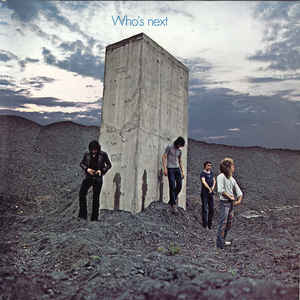
The Who’s “Who’s Next”

The Who's "Who's Next" album cover

I’ve been listening to The Who‘s 1971 LP “Who’s Next” for lessons I can learn as a songwriting musician. I wasn’t much into the Who growing up. My parents had the soundtrack to Tommy; This was not the album “Tommy,” but rather the songs re-recorded with performers from the film adaptation. I loved it growing up, fascinated by the apparent story from a movie I wasn’t allowed to see. From oldies stations, I knew a handful of their earlier songs.

In my late teens, I saw the film “Quadraphenia” on IFC at night. I fell in love immediately.  Soon, I discovered that my father-in-law had a copy of the album which I borrowed and never returned. This has long been my favorite Who album. When I went to school for painting, I probably annoyed my studio mates with the frequency I played it. Anyway, except for a couple of songs, I wasn’t really too familiar with “Who’s Next” and I found this album to be great as well; Not as a solid work like “Quadraphenia,” but better perhaps as a collection of individual songs.

The album opens with the electric arpeggio texture of an analog synthesizer. That synth may’ve been an EMS Synthi like Pink Floyd on Dark Side of the Moon. This is joined by piano playing chords in a two bar pattern. This hits the first and fourth beat of the one measure, which leads into the second measure where one the first beat is struck. The bass and guitar soon join in giving this simple rhythm an epic percussive sound. Of course, alongside the constant synth, Keith Moon drives away on the drums. He uses the crash cymbals to emphasize the rhythm. This rhythmic pattern of hitting the first beat of each measure and using the fourth beat to lead into the next second measure gets used in some form throughout the album.

The chords played here follow a classic rock I-V-IV pattern. Though occasionally the order may change some, this is effectively a three chord rocker. The chorus takes a break from the big rock pattern with a V-I-V-IV-I-V-IV pattern coming solely from the synth.  

Roger Daltrey’s vocals complete the sound of the song; they fill it with that punk rock musical passion that The Who were able to pull off. He sings “Out here in the fields, I fight for for my meals, I get my back into my living.” It’s important to know that several of this album’s songs where originally written for a scrapped rock opera called “Lifehouse.” this opening track was to be sung by a farmer heading into London. Townshend wrote the “teenage wasteland” bit as a bit of negative reaction to seeing drugged-out kids at Woodstock

The fourth track “My Wife” was also one of my favorites this week. The use of horns during the second half of the song, really just to punctuate the beat, got my attention first. Each measure start with a full chord strum on the first beat. Again, we hear that classic Townshend straight-forward overdriven electric guitar sound. I think it’s fantastic. Then there’s some partial strums, occasional muted lower notes and arpeggio higher notes. The piano plays syncopated chords bouncing in rhythmic conversation with the guitar. This conversation has been emphasized by panning the guitar left and the piano right. 

The chord progression is not as heavy as the I-IV-V of the first track. I’m not sure I’m getting this right, but this is what I believe the chord progression to be. The verse is I-VI♭-VI♭-IV-III♭-III♭-IV-I then ii-ii-VI♭-IV-III♭-VI♭-V-V. So much for the class rock progressions we heard earlier in the album! This is more the sort of stuff you’d expect from Cole Porter. Rock music typically doesn’t use so many chords in one song, especially borrowed chords.

The track is a bit of a folk-country ballad (in the classic ballad sense) with the Who rock sound. The speaker tells the story of how he got thrown in jail for getting drunk and the trouble he’s in at home because his wife thinks he was with another woman. The tale is dated, but it does make for a good song.

The closing track “Won’t Get Fooled Again” stands as one of the Who’s strongest and most iconic songs. (I’ll reuse the word “iconic” in a bit) The song starts with a lone overdriven guitar power chord that fades out naturally. Beneath this flows another pulsating rhythmic arpeggio synth texture similar to the opening “Baba O’Riley.” Pete Townshend explained the sound is actually an organ played through a sample-and-hold modulated filter. This is heard clean in the left channel with through a delayed-reverb in the right channel to give it depth.

The verses run a I-IV-I-IV-I-IV-V-V chord progression. The chorus also make use of a repeating I-IV progression, though at twice the speed and close with III-V7-III-V7-III-IV-IV7-I. That major III in the chorus gives a more majestic feel than the typical minor iii. Also to be noted is that Pete Townshend prefers to give these more rocking strong anthems simpler chord progressions. These gives the listener something easier to immediately grab unto.  Also, again, the majority of the guitar work is bursts of overdriven strums allowed to ring out. It’s also worth noting that, except for vocals, The Who don’t really have a lead instrument. So, Townshend at times will ramp up from rhythm guitar to a lead-rhythm. 

This 8 minute 33 second song is the climactic closer of the album. At 7:44, Roger Daltrey produces a nearly four second scream of “Yeah!” that is the climax of the song. It also remains one of rock n roll’s most iconic moments. That filtered organ sound is another, and they’re both in the same track. After that “yeah,” he delivers the punch-line (and message) of this lyrics about revolutions: “Meet the new boss, same as the old boss.” After this, the song quickly wraps up The song leads up to that 7:44 mark. A first-time listener might not be aware what they are building up to, but Townshend and crew were seemingly aware that repeat listeners would be. They give a similar moment at 4:29, with a 2 second “yeah” that does not have quite the same power but does tie the two parts of the song together. 

This is an amazing album from start to finish; It really shows what can be done with the essential instruments of rock n roll (drums, bass, guitar, vocals) in the hands of impassioned talented experts. Each member of the band is amazing at what they do. True, Pete Townshend is typically not playing anything technically difficult or complex. People who love Joe Satriani’s showy lead guitar are not necessarily going to be impressed, but I am. Keith Moon always impresses me. I’ve often heard complaints that he didn’t know when to calm down, but I think they just aren’t hearing the whole catalog. Anyway, I love this album.  I still think “Quadraphenia” is better, but we don’t really need to compare, do we?

Carole King’s “Tapestry”

Carole King Tapestry album cover

For the past week, I’ve been listening to Carole King’s 1971 album “Tapestry” for lessons I can learn as a songwriting musician. I’ve been more than aware of this album for years. From basement sales, I’ve managed to pick up two copies of it based on the feeling that I should appreciate it. And each time I’ve tried it, I would be disappointed. 

The songwriting is there, but these feel more like demo recordings to me. The musicians are surely capable, but generally play these songs straight. I feel they could use more playfulness and invention that may’ve come from working and reworking the songs. The vocals are adequate and often expressively intimate, but too frequently they feel thin and lacking in confidence. I know that Carole King had written a great many songs for other performers. Frequently, I feel that her performances here are an example of how the song could be sung rather than actually being a performance.

The songwriting is there, but these feel more like demo recordings to me. The musicians are surely capable, but generally play these songs straight. I feel they could use more playfulness and invention that may’ve come from working and reworking the songs. The vocals are adequate and often expressively intimate, but too frequently they feel thin and lacking in confidence. I know that Carole King had written a great many songs for other performers. Frequently, I feel that her performances here are an example of how the song could be sung rather than actually being a performance.

One of the best songs on the album, “It’s too Late,” has a wonderful vocal performance and accompaniment. I contradict my previous assessment of the album’s weaknesses by then talking about this track. However, I do want to talk about what I liked. On this song, poet Toni Stern wrote the lyrics with Carole King writing the music. King’s piano provides the main rhythm and chords for the song, with bass guitar, drums and congas further filling in the chord progression and rhythm. An electric guitar panned left and an electric piano panned right interact with each other across the centered piano chords. The syncopated rhythms of the melody and upbeat tempo of this minor key ballad seem to encourage King to sing with wonderful energy and confidence. 

With “Way Over Yonder,” King provides a soulful track performed with a gospel sentiment. Melody drives the song, carried well by King’s vocals. This is also one of the looser performances on the album; The loose performance, with the piano coming in and out of swing and syncopated time, lends the song a greater human emotional feeling. The slow pace along with three steps leading to each chord change gives the song soul.

The lyrics focus on a life of happiness and sweetness as a goal in life. This vision is presented like a gospel hymn on the promise of heaven. “I know when I get there, the first things I’ll see, is the sun shining golden. Shining right down on me.” Whereas those hymns have an overall optimistic sense of hope; I appreciate that this song has more a sense of longing.

King provides her own take on her song “Will You Love Me Tomorrow?” which was originally famously performed by the Shirelles. The Shirelles version, I believe, is featured in one of my favorite movies, “Big Wednesday.” Both versions are performed like a doo-wop ballad. However, the chord progression is not the 50s doo-wop progression, but rather a I-IV-V-I-V-IV♭-IV-iv for the verses. I love the sound of the V-IV♭-IV-iv. The use of the borrowed IV♭ feels like we’re going into a key change, but then we’re brought back to the IV, which gets dropped to a minor at the end of the line. The chord progression is emotionally very effective. 

Overall, I’m still not a fan of this album.  Martika did a great high-energy pop version of “I Feel the Earth Move” in 1989. Having grown up hearing that cover, I find Carole King’s more straight-forward performance to be a lackluster start of the album. So, the album was actually more enjoyable for me if I skipped the first track. However, most of the songs I would love to hear as performed by other musicians, with the exception of “It’s too late” which I love as is.

The Jimi Hendrix Experience’s “Electric Ladyland”

This week, I’ve been listening to the 1968 album “Electric Ladyland” by the Jimi Hendrix Experience. About six months ago, I spent time with their first album “Are you Experienced?” That album was released just 17 months before this, their third and final album.

They certainly evolved over this short period of time. While I truly enjoyed their debut album, I absolutely loved this one. The first album was more of a psychedelic blues rock. This album takes that sound and launches into the stratosphere, pushing the experimental psychedelic elements. They’ve also folded in some ingredient of soul and funk.

The album opens with intro track  “And the Gods Made Love” which is some slowed down stuff. It’s kind of neat the first couple times and then I found it annoying. I wanted to talk here about the first real song 
Have You Ever Been (To Electric Ladyland),” but I like to include a video link of the songs here and it’s not available on YouTube. Anyway, it is a great track and from the first thirty seconds, I knew I was going to love the album. It’s opens as a rather soulful funk-aware R&B song. Strange things are happening with the rhythms as the song seems to swirl upon itself. Experimental yet immediately accessible.

The Jimi Hendrix Experience recorded a fantastic cover of Bob Dylan‘s song “All Along the Watchtower” for this album. From what I’ve read, Hendrix got ahold of Dylan recording pretty early and liked this song immediately. The Experience worked on their cover for a few months and it was released within a year of Dylan’s original.  As great as Dylan’s lyrics are, the incredible soundscape of Hendrix’s version towers above the words. I know many of the words, but don’t really know what the song is about because what’s happening musically is so amazing. The verses serve more as passing narrative between the real action: Jimi’s lead guitar. 

A twelve-string acoustic guitar strums the chords throughout the song simply.  The lead guitar gives the track much of its psychedelic blues rock flavor. Jimi’s plays his stratocaster through a chorus and fuzz, with expressive filter modulation provided by a wah pedal. This sound of this combination of guitar and effects is all over the album. To see how the wah pedal is used to create these sounds, check out this excellent video by fuzzfaceexp. Some additional use of delay provides depth to the leads as well.

Another great song is “Voodoo Child (Slight Return)” towards the end of the album. Again, the track mostly provides a space for Jimi’s chorus-fuzz-wah lead guitar to soar into wildly expressive explorations of sound. This starts with the opening measures, one of the Hendrix’s most famous riffs. One that I, unfortunately must admit, first hear in middle school as sampled in a 2 Live Crew song. The Hendrix track has a marvelously live jam quality to it; Even though it features use of overdubbing additional tracks, it was initially created as a jam.

I continue my complaint about the Jimi Hendrix Experience and overuse of stereo panning as an effect. Sometimes it adds something to a song, but mostly I find it annoying and distracting. Better, I feel to use panning of a delay effect, but that may not have been as readily an option as it is today.

Overall, I loved the album “Electric Ladyland.” There’s more playful experimentation than found on “Are You Experienced?” as well as a greater sense of skill and experience with their direction and recording.  Great album.

Leonard Cohen’s “Songs of Leonard Cohen”

This week, I’ve been listening to Leonard Cohen’s debut album “Songs of Leonard Cohen” from 1967. My girlfriend introduced me to Leonard Cohen by giving me a copy of the Phil Spector produced album”Death of a Ladies’ Man.” I slowly grew a deep appreciation for the songs on that album.  The production was like something from a dream; The recordings smelled faintly of liquor and cigarettes.  “Death of a Ladies’ Man” provided a cool, yet haunting, melancholic atmosphere through lyrics, performance and production.

I’ve been looking forward to this week with “Songs of Leonard Cohen.” At first, I was a bit disappointed by the sound. The vocals were too intimately languid and the atmosphere was much different than the Phil Spector produced album. Known as a poet before starting his music career, Cohen writes amazing lyrics. I loved them from first listen and my appreciation for them developed over the week. The music also grew on me as well. The vocals aren’t quite to my taste, but I appreciate that they suit the songs. There’s quite a bit for a songwriting musician to learn form here, especially the lyrics.

“Sisters of Mercy” got my attention first.  The songs of this album are vocal and acoustic guitar based. Any other instrumentation is there to provide support or background. This song features a jangly mixture of instruments in the background that sound like a French street band. This band consists of accordion, glockenspiel, some light percussion. The atmosphere that they provide captured my heart before the lyrics. 

Those lyrics tell a simple story of a passing interaction with two young women whom Cohen had given a place to stay. After some conversation and then seeing them sleep, he was inspired to write “Sisters of Mercy.” According to this tale, he was the person that provided charity to them, not the other way around. However, it seems that they left brightened his evening and left a lasting impression. 

Having bestowed upon them the title of “sisters of mercy,” he continues with references to religious symbolism throughout the song. In the third of the four stanzas, he elevates their conversation to the point of an awakening or spiritual conversion. The confession he mentions in this verse probably refers to the previous verse where he tells of leaving his family and his own soul. He admits to feeling lonely as a sort of punishment for his actions. “When you’re not feeling holy, your loneliness says that you’ve sinned.” It’s not clear to me if he says this, or the Sisters do. Like Jesus touched the eyes of the blind, they have given him a new perspective on life and he honors them for it.

Well they lay down beside me, I made my confession to them.
They touched both my eyes and I touched the dew on their hem.
If your life is a leaf that the seasons tear off and condemn
They will bind you with love that is graceful and green as a stem.

The track “Suzanne” introduces the sound of the album well. Broken chords gently played on acoustic guitar start the track to be joined by Cohen’s reserved vocals. Even the chord progression is a gentle one: I-ii-I-iii-IV-I-ii-I-ii-I for the verses and iii-IV-I-ii-I for the chorus. The verse chord progression rises during the first half across the ii, iii, and IV, to return to ii in the second half. The steps back to the tonic chord keep the progression gently seated. The melody, too, rises and falls. 

There are three verses, each followed by a chorus. The verse follow a rhyme scheme of AABB for the first four lines and then the next two or three lines rhyme, but not following a consistent pattern. Most of the rhymes are slant. In the final verse, he rhymes “river” with “forever” and then “harbor” with “flowers” for the first two lines. The last three lines end with “morning” which somewhat ties together the rhyme of final two lines “forever” and “mirror.”

One could potentially class the titular Suzanne as a manic pixie dream girl. This woman that’s “half crazy (that’s why you want to be there)” takes the listener on a journey of discovery. She knows where the heroes are, even in the most unexpected places. This perspective on life is her gift. In the second of the three verses, where I believe the second person is shifted to Suzanne, the focus is on Jesus, whom Cohen describes as broken, forsaken. Even “he sank beneath your wisdom like a stone.” 

Suzanne takes you down to her place by the river
You can hear the boats go by you can spend the night forever
And the sun pours down like honey on our lady of the harbor
And she shows you where to look among the garbage and the flowers
There are heroes in the seaweed, there are children in the morning
They are leaning out for love and they will lean that way forever
While Suzanne holds the mirror

Bob Dylan’s “Blood on the Tracks”

Bob Dylan's "Blood on the Tracks" album cover This week, I’ve been listening to Bob Dylan’s 1975 album “Blood on the Tracks” to improve my craft as a songwriting musician. Each Bob Dylan album so far has been monstrously impressive from a songwriting perspective. His skill to employ metaphor within narrative songs that utilize rhyme is astounding. For me, this album is right up there with “Blonde on Blonde” and I can’t get enough of it now that I’ve spent a week with it.

Finger-picked blues guitar drives the track “Meet Me in the Morning.” At first, I didn’t care for this song due to its repetitive nature. A twelve bar blues progression (I-I-I-I-IV-IV-I-I-V-V-I-I) provides foundation upon which Dylan sings lyrics that follow the twelve-bar blues blues format of one line repeated twice, then a line in response. Like much of the album, the lyrics deal with a struggling relationship.

The first verse opens with the title “Meet me in the morning, 56 and Wabasha. Honey, we could be in Kansas by the time the snow begins to thaw.” I’m not sure why they are meeting to travel, except perhaps as a change of scenery or escape. The next verse tells how some say it’s darkest before the dawn, but the singer is always dark. But, when the morning rooster crows in the third verse, the singer feels mistreated by his lover. He feels persecuted and trapped, and wonders if the love was a curse. “Look at the sun sinking like a ship. Ain’t that just like my heart, babe, When you kissed my lips?”

I loved this catchy song by the end of the week. I like the layers of multiple guitars.  In the right channel , a bright acoustic guitar plays rhythm-lead lines. A fuzzy slide guitar soaked in reverb provides some atmosphere in the background. Another acoustic guitar quietly strums the chords. And yet clean electric guitar joins later to pick some lead lines and also gets in conversation with the fuzz guitar during the outro.

Also, I find it impossible to not sing along to the mellow grooving bassline.

On “Shelter From the Storm,” Dylan sings tenderly of a love lost. The jangly acoustic guitar dances nervously between the bass and vocals. We hear the sound of the pick and/or guitar strap ticking and rattling against the guitar. These additional sounds of guitar-playing unintentionally provide the only percussion. This type of natural imperfections lends a sense of authenticity to the recording. The chord progression throughout is a basic I-V-IV-I, with the melody providing a sense of variation through the verses.

These are some tremendous lyrics. The song is about confusion, loss, frustrations and heartache, but he’s telling it through the sweetness and tenderness. That’s how the song manages to be so powerful.  Rather than talking so much about pain and loss, he talk about promises and what was lost. However, it’s the middle verse that puts everything in perspective.

Now there’s a wall between us, something there’s been lost
I took too much for granted, I got my signals crossed
Just to think that it all began on an uneventful morn
Come in, she said, I’ll give you shelter from the storm

Of course, there’s layers of ambiguity here as other themes become part of the picture. Images of Christ come into play, which could embarrassingly make a martyr out of the speaker, but I prefer to avoid that interpretation.  It’s too mighty a structure of self-pity, and also would be too self-righteous in contrast to other statements in the song.

The brilliant “Tangled Up in Blue” opens the album and remained my favorite song the full week. I rather feel it’s too great of a song to be the first. The opening chords of A and Asus4 play in my head all day. The verses are in a I-VIIb-I-VIIb-I-VIIb-I twice, followed by V-vi-I-IV twice and ends with VIIb-IV-I for the refrain of “Tangled up in blue.”

The first half of each verse is sung in a restrained back-and-forth melody, with the pitch rising for the second half. The percussion and other instruments likewise pick up in energy. This is balanced by the lower-pitched chords of E and F#m. The the refrain anchors the verse back to the tonic on “blue.” It’s interesting the use of chords for this key. The chords are more likely those of a song in the key of G, while the melody is actually in key of A.

As with the whole album, the layering and interplay of instruments is fantastic. Multiple strummed and picked acoustic guitars provide a full atmosphere of sound. Still they are mixed in a way that manages to keep things feeling stripped down.

The lyrics are the most amazing part of the song. A week definitely provides too little time to fully appreciate all he has going on here. At the very basic level, I appreciate the narrative quality of the song. Songs that tell stories, especially about characters and their relationships, get my interest. I especially appreciate tales of that touched on and lost and over-arching tales that narrow in on details. This is especially made poignant by going back to a place while accentuating the distance.

So now I’m going back again,
I got to get to her somehow.
All the people we used to know
They’re an illusion to me now.
Some are mathematicians
Some are carpenter’s wives.
Don’t know how it all got started,
I don’t know what they’re doing with their lives.
But me, I’m still on the road
Heading for another joint
We always did feel the same,
We just saw it from a different point of view,
Tangled up in blue.

Pixies’ “Doolittle”

Pixies' Doolittle album cover This week, I’ve been listening to the Pixies‘ 1989 album “Doolittle.” My introduction to this alt-rock guitar band probably came through Nirvana and the Breeders. You can definitely hear that Nirvana influence coming from songs like “Tame.” “Doolittle” was nearly a decade old by the time I heard it. Though I know a few of the songs, this week was really my first time getting to know the whole album.

This Pixies album album sounds very 90s, even though it came out before music that typifies the 90s. At the time, it must’ve seemed so strange and new. It’s still unusual today, but definitely sounds dated. Just strange that it sounds dated to a time after it came out. That’s how influential it was.

I fell in love with “Monkey Gone to Heaven” the first time I heard it, whenever that was. The unusual start of the song caught my attention. A series of ascending chords drive out of nowhere, drums begin, then a hit from the bass as if this song is going to rock. Then.. a pause and the vocals calming state “There was a guy.” Instead of rocking, the collected and slightly menacing voice, tells us a story like recalling a legendary news item: “An underwater guy who controlled the sea got killed by ten million pounds of slugs from New York and New Jersey.” That’s the first verse: Nonsense that seems to make sense. The chorus consists of the line “This monkey’s gone to heaven” repeated four times.

“Here Comes Your Man” provides a great example of something I noticed throughout the album. The guitars often play monophonic surf-rock inspired lines. There’s not so much strumming of full chords as usually found in rock music. The album also features a lot more clean, or at least less distorted, guitar than I would’ve expected. When guitars are distorted or fuzzed, they are mixed further back than the clean guitars, providing more of a pad than a heavy drive.

The nearly instrumental “La La Love You” songs also features a lot of surf-rock style lead guitar. Again, this track opens with some rockin’ drums and then takes a mellow turn. It borders on instrumental cheese and surf rock. I love the bright clean electric with dripping reverb sound. The bass rolls along uninterestingly, which is actually in contrast to most of the album where the bass carries much of the instrumentation. The lyrics aren’t much, but that’s really the point. “All I’m sayin’ pretty baby, La la love you, don’t mean maybe.” is repeated several times as the song ends. In a way this song seems to represent much of what the undercurrent of the album: It’s an angular love-affair with rock n roll; it attacks what it loves.